Product Design
Pharmacatalyst - A supperApp
An AI-assisted platform that helps pharma teams create campaigns, generate promotional assets, and prepare MLR-ready content with less rework and clearer version control.
My Role :
0-1 Product Designer
Industry :
Pharma / Healthcare (B2B)
Year(s) :
2023-2024
Project Duration :
10 weeks
Tools :
Figma, Miro, JIRA and hotjar



Project Overview
PharmaCatalyst is a next-generation “super app” designed to streamline and centralize the creation of promotional content in the highly regulated pharmaceutical industry. From concept to final delivery, PharmaCatalyst consolidates every step, ideation, content generation, review, and compliance checks, into a single, user-friendly hub. By leveraging AI-powered modules, teams can produce engaging banners, videos, and written assets tailored to meet stringent regulatory requirements while accelerating overall time-to-market.
Problem
How might we use AI to accelerate pharmaceutical campaign creation from brief to promotional assets while ensuring content stays MLR-ready, traceable, and free of version-control errors?
Problem
How might we use AI to accelerate pharmaceutical campaign creation from brief to promotional assets while ensuring content stays MLR-ready, traceable, and free of version-control errors?
Problem
How might we use AI to accelerate pharmaceutical campaign creation from brief to promotional assets while ensuring content stays MLR-ready, traceable, and free of version-control errors?
Goal
Create an AI-first, centralized platform that turns pharma campaign briefs into compliant, MLR-ready promotional assets with built-in version control so teams can reduce bottlenecks and launch engaging campaigns faster.
Goal
Create an AI-first, centralized platform that turns pharma campaign briefs into compliant, MLR-ready promotional assets with built-in version control so teams can reduce bottlenecks and launch engaging campaigns faster.
Goal
Create an AI-first, centralized platform that turns pharma campaign briefs into compliant, MLR-ready promotional assets with built-in version control so teams can reduce bottlenecks and launch engaging campaigns faster.
My Responsibilities
End-to-end workflow for Campaigns → Projects → AI Content → MLR Readiness
IA + navigation (Home, Projects, Conversation, Workflow, Configuration, Library)
Wireframes → high-fidelity UI for the main dashboard + key modules
My Responsibilities
End-to-end workflow for Campaigns → Projects → AI Content → MLR Readiness
IA + navigation (Home, Projects, Conversation, Workflow, Configuration, Library)
Wireframes → high-fidelity UI for the main dashboard + key modules
My Responsibilities
End-to-end workflow for Campaigns → Projects → AI Content → MLR Readiness
IA + navigation (Home, Projects, Conversation, Workflow, Configuration, Library)
Wireframes → high-fidelity UI for the main dashboard + key modules
Research
Process
Stakeholder Interviews & Workshops
Marketing & Brand: Needed faster campaign turnarounds, consistent messaging, and clear ownership across teams. Creative & Content: Wanted clearer briefs, fewer revisions, and a reliable “latest version” of assets. Medical/Legal/Regulatory (MLR): Asked for claim traceability, required metadata, and consistent review structure to reduce back-and-forth. Shared takeaway: Speed matters, but only if outputs are review-ready and version-safe.
Observational & Contextual Inquiry
Workflow shadowing: Mapped the real “brief → draft → review → rework → approve” loop and where time is lost (tool switching, missing context, unclear feedback). Artifact review: Studied briefs, submission forms, and review checklists to understand what “MLR-ready” actually requires. Bottleneck analysis: Identified the biggest delays: unclear briefs, scattered comments, and late-stage compliance fixes.
Competitor & Market Analysis
Landscape scan: Reviewed tools for AI content generation, asset management, approvals, and compliance—but found they solve only parts of the workflow. Gap identified: No single solution connected AI creation + structured metadata + review readiness + version history end-to-end. Benchmarking: Noted best practices (templates, modular content, audit trails) and weaknesses (generic AI outputs, weak compliance structure).
Iterative Design & Refinement
Landscape scan: Reviewed tools for AI content generation, asset management, approvals, and compliance—but found they solve only parts of the workflow. Gap identified: No single solution connected AI creation + structured metadata + review readiness + version history end-to-end. Benchmarking: Noted best practices (templates, modular content, audit trails) and weaknesses (generic AI outputs, weak compliance structure).
Stakeholder Interviews & Workshops
Marketing & Brand: Needed faster campaign turnarounds, consistent messaging, and clear ownership across teams. Creative & Content: Wanted clearer briefs, fewer revisions, and a reliable “latest version” of assets. Medical/Legal/Regulatory (MLR): Asked for claim traceability, required metadata, and consistent review structure to reduce back-and-forth. Shared takeaway: Speed matters, but only if outputs are review-ready and version-safe.
Observational & Contextual Inquiry
Workflow shadowing: Mapped the real “brief → draft → review → rework → approve” loop and where time is lost (tool switching, missing context, unclear feedback). Artifact review: Studied briefs, submission forms, and review checklists to understand what “MLR-ready” actually requires. Bottleneck analysis: Identified the biggest delays: unclear briefs, scattered comments, and late-stage compliance fixes.
Competitor & Market Analysis
Landscape scan: Reviewed tools for AI content generation, asset management, approvals, and compliance—but found they solve only parts of the workflow. Gap identified: No single solution connected AI creation + structured metadata + review readiness + version history end-to-end. Benchmarking: Noted best practices (templates, modular content, audit trails) and weaknesses (generic AI outputs, weak compliance structure).
Iterative Design & Refinement
Landscape scan: Reviewed tools for AI content generation, asset management, approvals, and compliance—but found they solve only parts of the workflow. Gap identified: No single solution connected AI creation + structured metadata + review readiness + version history end-to-end. Benchmarking: Noted best practices (templates, modular content, audit trails) and weaknesses (generic AI outputs, weak compliance structure).
Stakeholder Interviews & Workshops
Marketing & Brand: Needed faster campaign turnarounds, consistent messaging, and clear ownership across teams. Creative & Content: Wanted clearer briefs, fewer revisions, and a reliable “latest version” of assets. Medical/Legal/Regulatory (MLR): Asked for claim traceability, required metadata, and consistent review structure to reduce back-and-forth. Shared takeaway: Speed matters, but only if outputs are review-ready and version-safe.
Observational & Contextual Inquiry
Workflow shadowing: Mapped the real “brief → draft → review → rework → approve” loop and where time is lost (tool switching, missing context, unclear feedback). Artifact review: Studied briefs, submission forms, and review checklists to understand what “MLR-ready” actually requires. Bottleneck analysis: Identified the biggest delays: unclear briefs, scattered comments, and late-stage compliance fixes.
Competitor & Market Analysis
Landscape scan: Reviewed tools for AI content generation, asset management, approvals, and compliance—but found they solve only parts of the workflow. Gap identified: No single solution connected AI creation + structured metadata + review readiness + version history end-to-end. Benchmarking: Noted best practices (templates, modular content, audit trails) and weaknesses (generic AI outputs, weak compliance structure).
Iterative Design & Refinement
Landscape scan: Reviewed tools for AI content generation, asset management, approvals, and compliance—but found they solve only parts of the workflow. Gap identified: No single solution connected AI creation + structured metadata + review readiness + version history end-to-end. Benchmarking: Noted best practices (templates, modular content, audit trails) and weaknesses (generic AI outputs, weak compliance structure).
user research
Users
Marketing / Brand teams: want speed, asset generation, campaign visibility
Content creators: want clear briefs + reusable components
MLR reviewers: want structured inputs, reduced ambiguity, and traceability
Admins/Ops: want governance, permissions, and workflow consistency
Users
Marketing / Brand teams: want speed, asset generation, campaign visibility
Content creators: want clear briefs + reusable components
MLR reviewers: want structured inputs, reduced ambiguity, and traceability
Admins/Ops: want governance, permissions, and workflow consistency
Users
Marketing / Brand teams: want speed, asset generation, campaign visibility
Content creators: want clear briefs + reusable components
MLR reviewers: want structured inputs, reduced ambiguity, and traceability
Admins/Ops: want governance, permissions, and workflow consistency
Pain Points
Campaign creation takes too long due to tool-switching and unclear ownership
Content feedback is scattered → rework loops
AI tools exist, but outputs aren’t structured for MLR-ready use
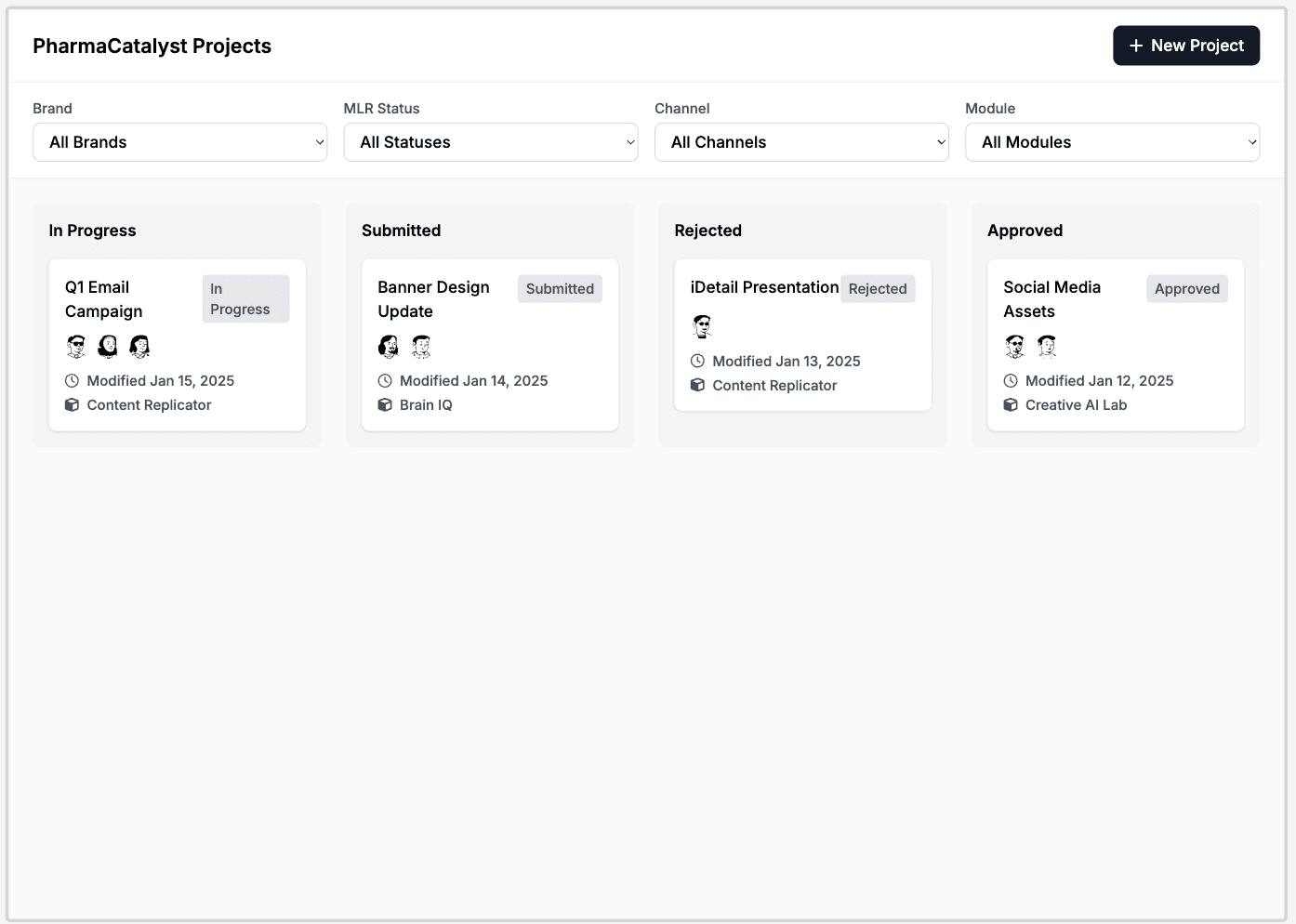
Teams need clarity: what’s in progress, what’s approved, what needs edits
Pain Points
Campaign creation takes too long due to tool-switching and unclear ownership
Content feedback is scattered → rework loops
AI tools exist, but outputs aren’t structured for MLR-ready use
Teams need clarity: what’s in progress, what’s approved, what needs edits
Pain Points
Campaign creation takes too long due to tool-switching and unclear ownership
Content feedback is scattered → rework loops
AI tools exist, but outputs aren’t structured for MLR-ready use
Teams need clarity: what’s in progress, what’s approved, what needs edits
Persona
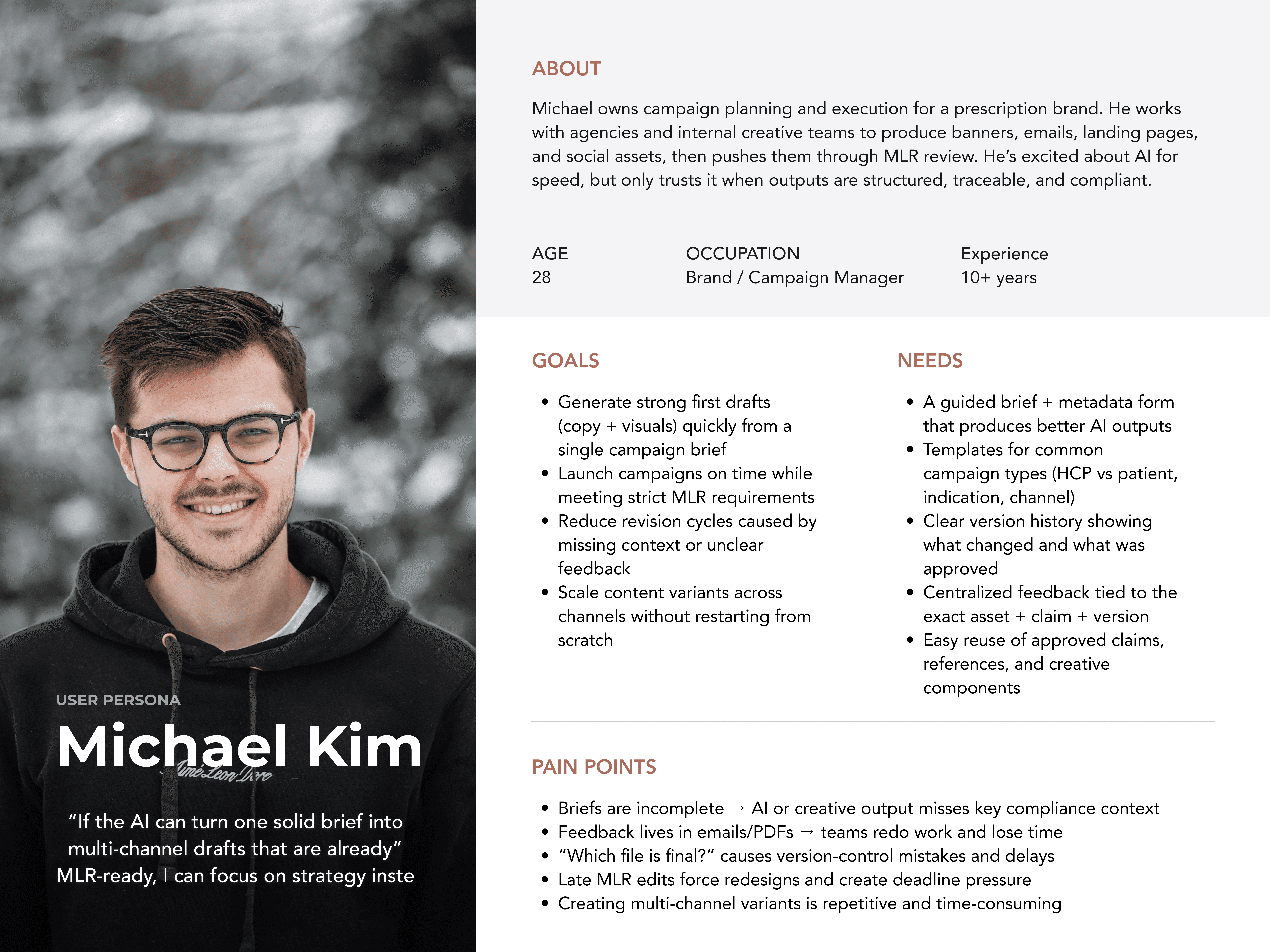
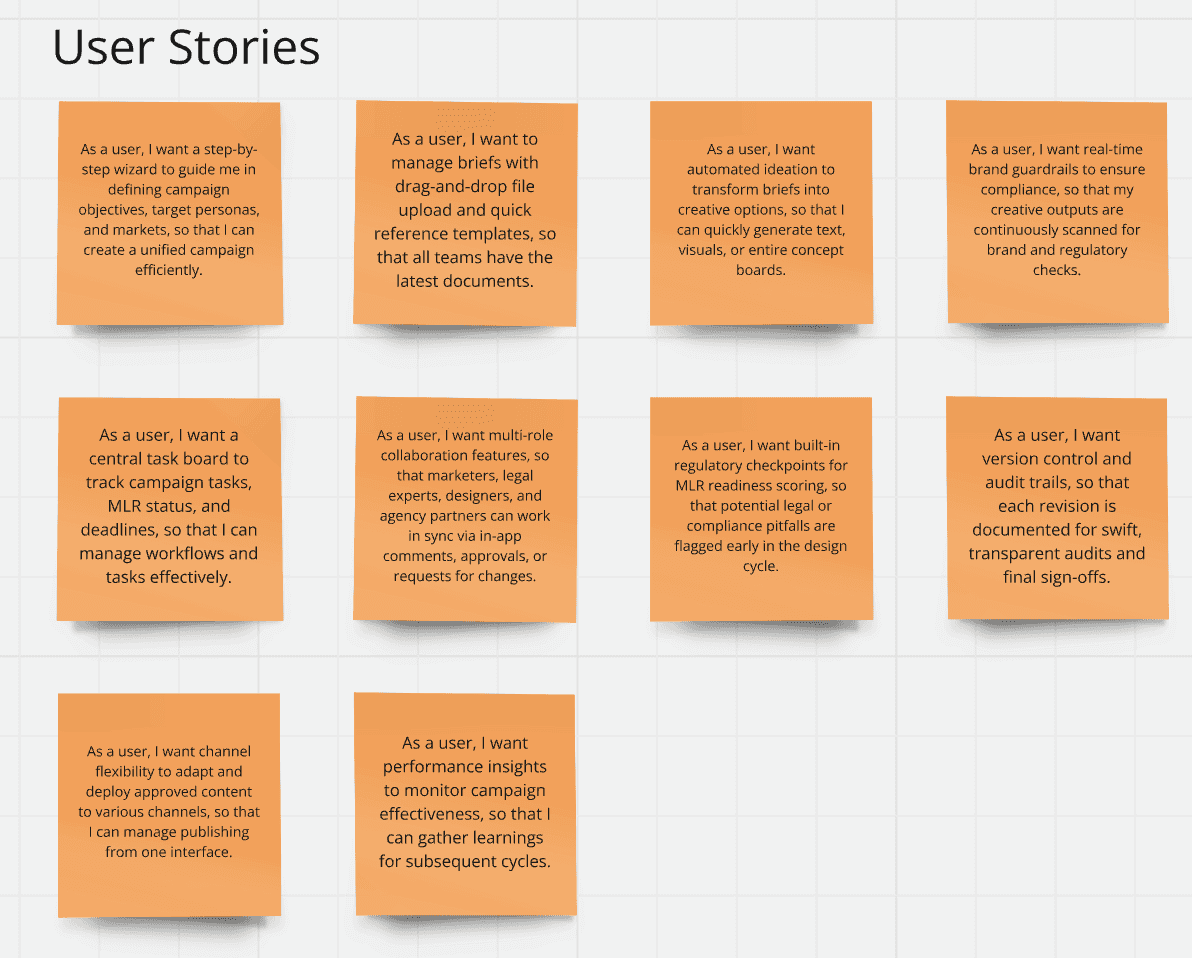
Design Thinking session + user requirement gathering


Design
Wireframe
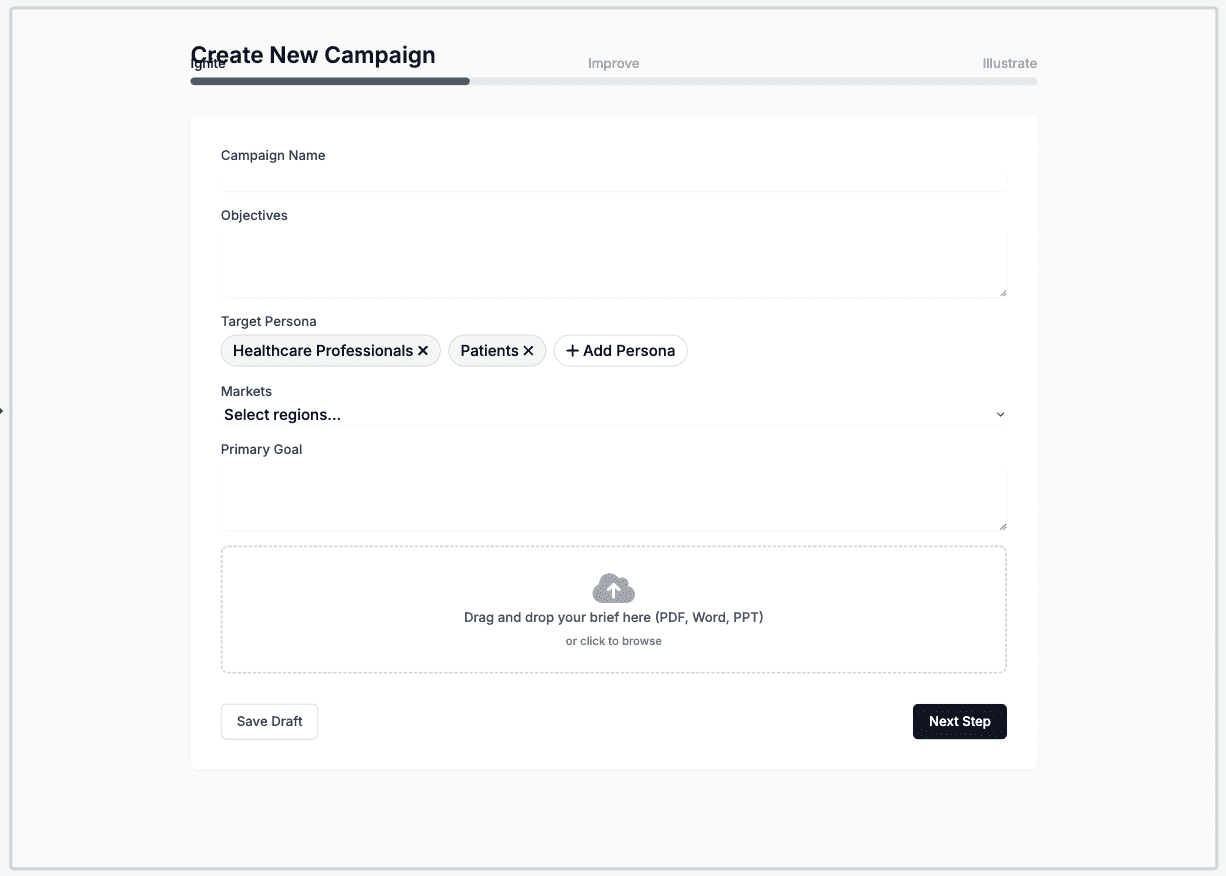
We identifieUnified Campaign & Project Creation
Users can establish a campaign or project as a central hub for all related assets, tasks, and outputs.
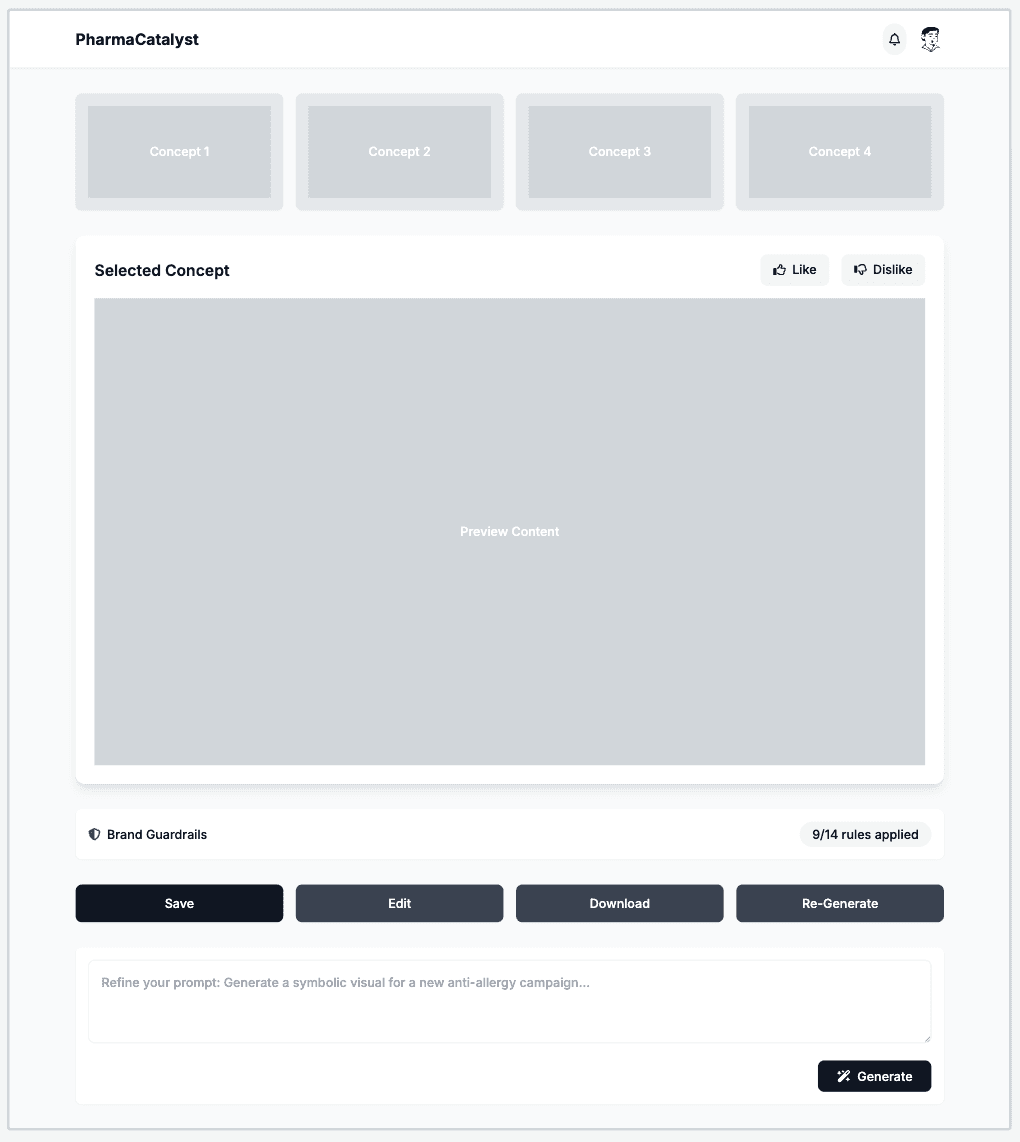
AI-Driven Content Generation (from brief + metadata)
Users provide a summary and metadata (such as drug, audience, channel, objective, claims constraints). The system then produces:
Drafts of promotional copy
Image concepts and creative variants
Reusable content blocks
Creative Generation Designed for Promotion
AI-generated visuals are created to be directly integrated into campaign materials like social media, emails, web banners, and more.MLR Readiness Support
Rather than addressing compliance at the end, the system structures content early on, enabling teams to:
Minimize back-and-forth revisions
Expedite review-ready package preparation
Maintain consistency of artifacts across iterations
Asset & Knowledge Reuse
A library combined with a replicator/transcreation tool helps reduce repetitive work and supports scaling across campaigns.
Final Version
Outcome
With PharmaCatalyst, pharmaceutical marketing teams can confidently ideate, create, review, and distribute promotional assets in a fraction of the time once required. By merging AI-powered innovation, regulatory intelligence, and collaborative workflows, this super app redefines how drug promotions are developed, enabling faster launches, improved compliance, and a strategically consistent brand experience worldwide.
Product Design
Pharmacatalyst - A supperApp
An AI-assisted platform that helps pharma teams create campaigns, generate promotional assets, and prepare MLR-ready content with less rework and clearer version control.
My Role :
0-1 Product Designer
Industry :
Pharma / Healthcare (B2B)
Year(s) :
2023-2024
Project Duration :
10 weeks
Tools :
Figma, Miro, JIRA and hotjar


Project Overview
PharmaCatalyst is a next-generation “super app” designed to streamline and centralize the creation of promotional content in the highly regulated pharmaceutical industry. From concept to final delivery, PharmaCatalyst consolidates every step, ideation, content generation, review, and compliance checks, into a single, user-friendly hub. By leveraging AI-powered modules, teams can produce engaging banners, videos, and written assets tailored to meet stringent regulatory requirements while accelerating overall time-to-market.
Problem
How might we use AI to accelerate pharmaceutical campaign creation from brief to promotional assets while ensuring content stays MLR-ready, traceable, and free of version-control errors?
Problem
How might we use AI to accelerate pharmaceutical campaign creation from brief to promotional assets while ensuring content stays MLR-ready, traceable, and free of version-control errors?
Problem
How might we use AI to accelerate pharmaceutical campaign creation from brief to promotional assets while ensuring content stays MLR-ready, traceable, and free of version-control errors?
Goal
Create an AI-first, centralized platform that turns pharma campaign briefs into compliant, MLR-ready promotional assets with built-in version control so teams can reduce bottlenecks and launch engaging campaigns faster.
Goal
Create an AI-first, centralized platform that turns pharma campaign briefs into compliant, MLR-ready promotional assets with built-in version control so teams can reduce bottlenecks and launch engaging campaigns faster.
Goal
Create an AI-first, centralized platform that turns pharma campaign briefs into compliant, MLR-ready promotional assets with built-in version control so teams can reduce bottlenecks and launch engaging campaigns faster.
My Responsibilities
End-to-end workflow for Campaigns → Projects → AI Content → MLR Readiness
IA + navigation (Home, Projects, Conversation, Workflow, Configuration, Library)
Wireframes → high-fidelity UI for the main dashboard + key modules
My Responsibilities
End-to-end workflow for Campaigns → Projects → AI Content → MLR Readiness
IA + navigation (Home, Projects, Conversation, Workflow, Configuration, Library)
Wireframes → high-fidelity UI for the main dashboard + key modules
My Responsibilities
End-to-end workflow for Campaigns → Projects → AI Content → MLR Readiness
IA + navigation (Home, Projects, Conversation, Workflow, Configuration, Library)
Wireframes → high-fidelity UI for the main dashboard + key modules
Research
Process
Stakeholder Interviews & Workshops
Marketing & Brand: Needed faster campaign turnarounds, consistent messaging, and clear ownership across teams. Creative & Content: Wanted clearer briefs, fewer revisions, and a reliable “latest version” of assets. Medical/Legal/Regulatory (MLR): Asked for claim traceability, required metadata, and consistent review structure to reduce back-and-forth. Shared takeaway: Speed matters, but only if outputs are review-ready and version-safe.
Observational & Contextual Inquiry
Workflow shadowing: Mapped the real “brief → draft → review → rework → approve” loop and where time is lost (tool switching, missing context, unclear feedback). Artifact review: Studied briefs, submission forms, and review checklists to understand what “MLR-ready” actually requires. Bottleneck analysis: Identified the biggest delays: unclear briefs, scattered comments, and late-stage compliance fixes.
Competitor & Market Analysis
Landscape scan: Reviewed tools for AI content generation, asset management, approvals, and compliance—but found they solve only parts of the workflow. Gap identified: No single solution connected AI creation + structured metadata + review readiness + version history end-to-end. Benchmarking: Noted best practices (templates, modular content, audit trails) and weaknesses (generic AI outputs, weak compliance structure).
Iterative Design & Refinement
Landscape scan: Reviewed tools for AI content generation, asset management, approvals, and compliance—but found they solve only parts of the workflow. Gap identified: No single solution connected AI creation + structured metadata + review readiness + version history end-to-end. Benchmarking: Noted best practices (templates, modular content, audit trails) and weaknesses (generic AI outputs, weak compliance structure).
Stakeholder Interviews & Workshops
Marketing & Brand: Needed faster campaign turnarounds, consistent messaging, and clear ownership across teams. Creative & Content: Wanted clearer briefs, fewer revisions, and a reliable “latest version” of assets. Medical/Legal/Regulatory (MLR): Asked for claim traceability, required metadata, and consistent review structure to reduce back-and-forth. Shared takeaway: Speed matters, but only if outputs are review-ready and version-safe.
Observational & Contextual Inquiry
Workflow shadowing: Mapped the real “brief → draft → review → rework → approve” loop and where time is lost (tool switching, missing context, unclear feedback). Artifact review: Studied briefs, submission forms, and review checklists to understand what “MLR-ready” actually requires. Bottleneck analysis: Identified the biggest delays: unclear briefs, scattered comments, and late-stage compliance fixes.
Competitor & Market Analysis
Landscape scan: Reviewed tools for AI content generation, asset management, approvals, and compliance—but found they solve only parts of the workflow. Gap identified: No single solution connected AI creation + structured metadata + review readiness + version history end-to-end. Benchmarking: Noted best practices (templates, modular content, audit trails) and weaknesses (generic AI outputs, weak compliance structure).
Iterative Design & Refinement
Landscape scan: Reviewed tools for AI content generation, asset management, approvals, and compliance—but found they solve only parts of the workflow. Gap identified: No single solution connected AI creation + structured metadata + review readiness + version history end-to-end. Benchmarking: Noted best practices (templates, modular content, audit trails) and weaknesses (generic AI outputs, weak compliance structure).
Stakeholder Interviews & Workshops
Marketing & Brand: Needed faster campaign turnarounds, consistent messaging, and clear ownership across teams. Creative & Content: Wanted clearer briefs, fewer revisions, and a reliable “latest version” of assets. Medical/Legal/Regulatory (MLR): Asked for claim traceability, required metadata, and consistent review structure to reduce back-and-forth. Shared takeaway: Speed matters, but only if outputs are review-ready and version-safe.
Observational & Contextual Inquiry
Workflow shadowing: Mapped the real “brief → draft → review → rework → approve” loop and where time is lost (tool switching, missing context, unclear feedback). Artifact review: Studied briefs, submission forms, and review checklists to understand what “MLR-ready” actually requires. Bottleneck analysis: Identified the biggest delays: unclear briefs, scattered comments, and late-stage compliance fixes.
Competitor & Market Analysis
Landscape scan: Reviewed tools for AI content generation, asset management, approvals, and compliance—but found they solve only parts of the workflow. Gap identified: No single solution connected AI creation + structured metadata + review readiness + version history end-to-end. Benchmarking: Noted best practices (templates, modular content, audit trails) and weaknesses (generic AI outputs, weak compliance structure).
Iterative Design & Refinement
Landscape scan: Reviewed tools for AI content generation, asset management, approvals, and compliance—but found they solve only parts of the workflow. Gap identified: No single solution connected AI creation + structured metadata + review readiness + version history end-to-end. Benchmarking: Noted best practices (templates, modular content, audit trails) and weaknesses (generic AI outputs, weak compliance structure).
user research
Users
Marketing / Brand teams: want speed, asset generation, campaign visibility
Content creators: want clear briefs + reusable components
MLR reviewers: want structured inputs, reduced ambiguity, and traceability
Admins/Ops: want governance, permissions, and workflow consistency
Users
Marketing / Brand teams: want speed, asset generation, campaign visibility
Content creators: want clear briefs + reusable components
MLR reviewers: want structured inputs, reduced ambiguity, and traceability
Admins/Ops: want governance, permissions, and workflow consistency
Users
Marketing / Brand teams: want speed, asset generation, campaign visibility
Content creators: want clear briefs + reusable components
MLR reviewers: want structured inputs, reduced ambiguity, and traceability
Admins/Ops: want governance, permissions, and workflow consistency
Pain Points
Campaign creation takes too long due to tool-switching and unclear ownership
Content feedback is scattered → rework loops
AI tools exist, but outputs aren’t structured for MLR-ready use
Teams need clarity: what’s in progress, what’s approved, what needs edits
Pain Points
Campaign creation takes too long due to tool-switching and unclear ownership
Content feedback is scattered → rework loops
AI tools exist, but outputs aren’t structured for MLR-ready use
Teams need clarity: what’s in progress, what’s approved, what needs edits
Pain Points
Campaign creation takes too long due to tool-switching and unclear ownership
Content feedback is scattered → rework loops
AI tools exist, but outputs aren’t structured for MLR-ready use
Teams need clarity: what’s in progress, what’s approved, what needs edits
Persona
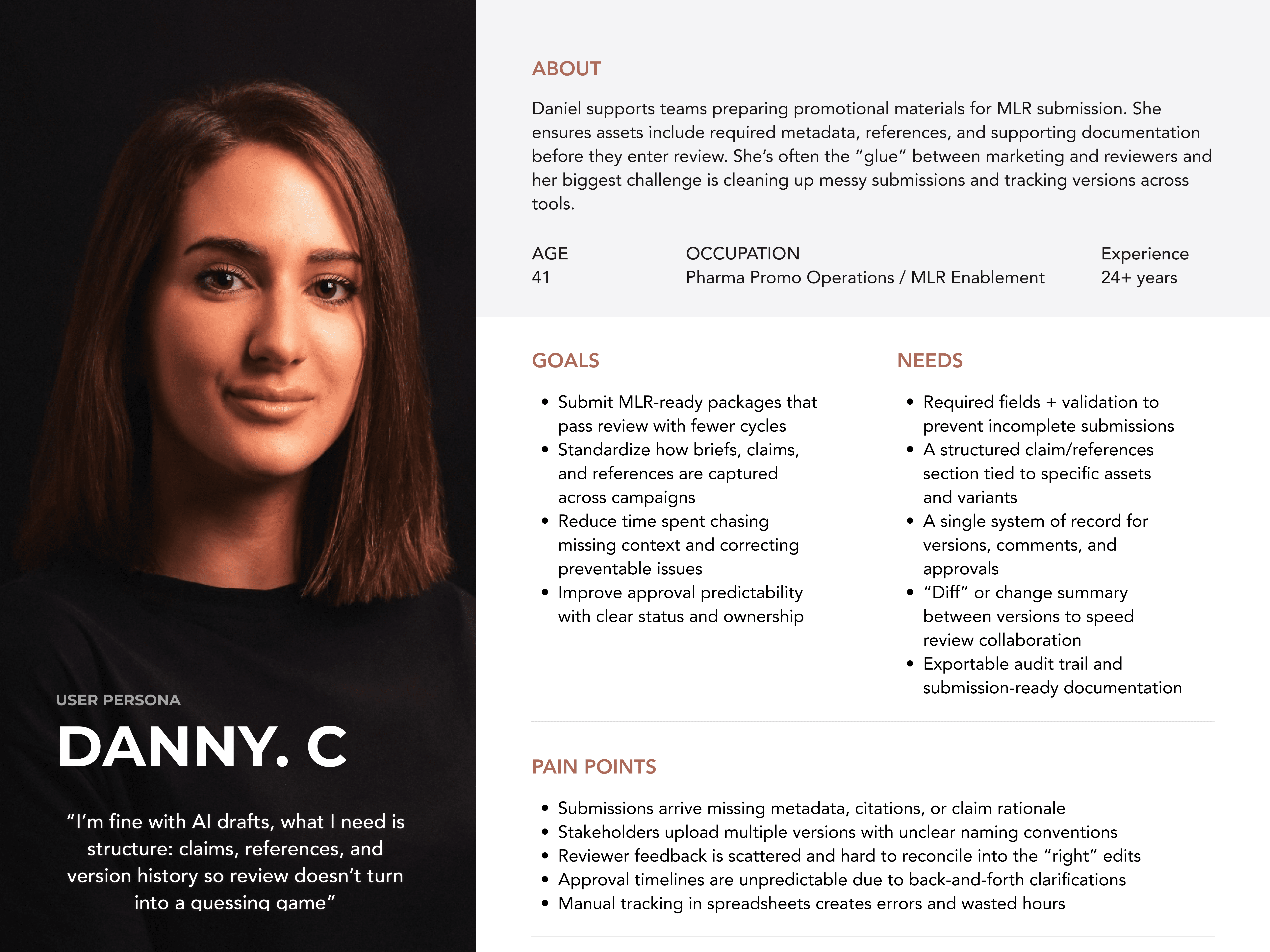
Design Thinking session + user requirement gathering
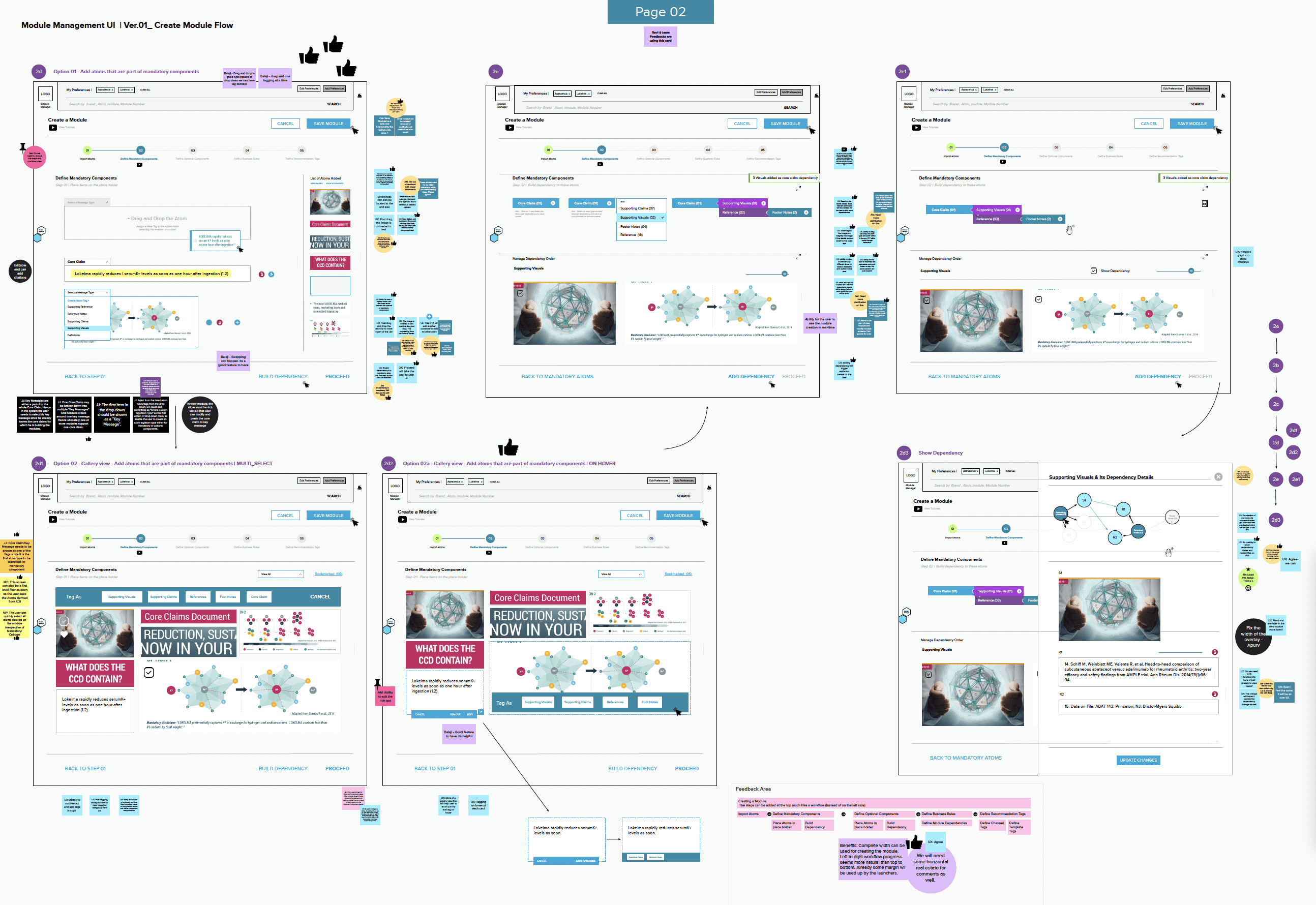


Design
Wireframe
We identifieUnified Campaign & Project Creation
Users can establish a campaign or project as a central hub for all related assets, tasks, and outputs.
AI-Driven Content Generation (from brief + metadata)
Users provide a summary and metadata (such as drug, audience, channel, objective, claims constraints). The system then produces:
Drafts of promotional copy
Image concepts and creative variants
Reusable content blocks
Creative Generation Designed for Promotion
AI-generated visuals are created to be directly integrated into campaign materials like social media, emails, web banners, and more.MLR Readiness Support
Rather than addressing compliance at the end, the system structures content early on, enabling teams to:
Minimize back-and-forth revisions
Expedite review-ready package preparation
Maintain consistency of artifacts across iterations
Asset & Knowledge Reuse
A library combined with a replicator/transcreation tool helps reduce repetitive work and supports scaling across campaigns.
Final Version
Outcome
With PharmaCatalyst, pharmaceutical marketing teams can confidently ideate, create, review, and distribute promotional assets in a fraction of the time once required. By merging AI-powered innovation, regulatory intelligence, and collaborative workflows, this super app redefines how drug promotions are developed, enabling faster launches, improved compliance, and a strategically consistent brand experience worldwide.
Product Design
Pharmacatalyst - A supperApp
An AI-assisted platform that helps pharma teams create campaigns, generate promotional assets, and prepare MLR-ready content with less rework and clearer version control.
My Role :
0-1 Product Designer
Industry :
Pharma / Healthcare (B2B)
Year(s) :
2023-2024
Project Duration :
10 weeks
Tools :
Figma, Miro, JIRA and hotjar


Project Overview
PharmaCatalyst is a next-generation “super app” designed to streamline and centralize the creation of promotional content in the highly regulated pharmaceutical industry. From concept to final delivery, PharmaCatalyst consolidates every step, ideation, content generation, review, and compliance checks, into a single, user-friendly hub. By leveraging AI-powered modules, teams can produce engaging banners, videos, and written assets tailored to meet stringent regulatory requirements while accelerating overall time-to-market.
Problem
How might we use AI to accelerate pharmaceutical campaign creation from brief to promotional assets while ensuring content stays MLR-ready, traceable, and free of version-control errors?
Problem
How might we use AI to accelerate pharmaceutical campaign creation from brief to promotional assets while ensuring content stays MLR-ready, traceable, and free of version-control errors?
Problem
How might we use AI to accelerate pharmaceutical campaign creation from brief to promotional assets while ensuring content stays MLR-ready, traceable, and free of version-control errors?
Goal
Create an AI-first, centralized platform that turns pharma campaign briefs into compliant, MLR-ready promotional assets with built-in version control so teams can reduce bottlenecks and launch engaging campaigns faster.
Goal
Create an AI-first, centralized platform that turns pharma campaign briefs into compliant, MLR-ready promotional assets with built-in version control so teams can reduce bottlenecks and launch engaging campaigns faster.
Goal
Create an AI-first, centralized platform that turns pharma campaign briefs into compliant, MLR-ready promotional assets with built-in version control so teams can reduce bottlenecks and launch engaging campaigns faster.
My Responsibilities
End-to-end workflow for Campaigns → Projects → AI Content → MLR Readiness
IA + navigation (Home, Projects, Conversation, Workflow, Configuration, Library)
Wireframes → high-fidelity UI for the main dashboard + key modules
My Responsibilities
End-to-end workflow for Campaigns → Projects → AI Content → MLR Readiness
IA + navigation (Home, Projects, Conversation, Workflow, Configuration, Library)
Wireframes → high-fidelity UI for the main dashboard + key modules
My Responsibilities
End-to-end workflow for Campaigns → Projects → AI Content → MLR Readiness
IA + navigation (Home, Projects, Conversation, Workflow, Configuration, Library)
Wireframes → high-fidelity UI for the main dashboard + key modules
Research
Process
Stakeholder Interviews & Workshops
Marketing & Brand: Needed faster campaign turnarounds, consistent messaging, and clear ownership across teams. Creative & Content: Wanted clearer briefs, fewer revisions, and a reliable “latest version” of assets. Medical/Legal/Regulatory (MLR): Asked for claim traceability, required metadata, and consistent review structure to reduce back-and-forth. Shared takeaway: Speed matters, but only if outputs are review-ready and version-safe.
Observational & Contextual Inquiry
Workflow shadowing: Mapped the real “brief → draft → review → rework → approve” loop and where time is lost (tool switching, missing context, unclear feedback). Artifact review: Studied briefs, submission forms, and review checklists to understand what “MLR-ready” actually requires. Bottleneck analysis: Identified the biggest delays: unclear briefs, scattered comments, and late-stage compliance fixes.
Competitor & Market Analysis
Landscape scan: Reviewed tools for AI content generation, asset management, approvals, and compliance—but found they solve only parts of the workflow. Gap identified: No single solution connected AI creation + structured metadata + review readiness + version history end-to-end. Benchmarking: Noted best practices (templates, modular content, audit trails) and weaknesses (generic AI outputs, weak compliance structure).
Iterative Design & Refinement
Landscape scan: Reviewed tools for AI content generation, asset management, approvals, and compliance—but found they solve only parts of the workflow. Gap identified: No single solution connected AI creation + structured metadata + review readiness + version history end-to-end. Benchmarking: Noted best practices (templates, modular content, audit trails) and weaknesses (generic AI outputs, weak compliance structure).
Stakeholder Interviews & Workshops
Marketing & Brand: Needed faster campaign turnarounds, consistent messaging, and clear ownership across teams. Creative & Content: Wanted clearer briefs, fewer revisions, and a reliable “latest version” of assets. Medical/Legal/Regulatory (MLR): Asked for claim traceability, required metadata, and consistent review structure to reduce back-and-forth. Shared takeaway: Speed matters, but only if outputs are review-ready and version-safe.
Observational & Contextual Inquiry
Workflow shadowing: Mapped the real “brief → draft → review → rework → approve” loop and where time is lost (tool switching, missing context, unclear feedback). Artifact review: Studied briefs, submission forms, and review checklists to understand what “MLR-ready” actually requires. Bottleneck analysis: Identified the biggest delays: unclear briefs, scattered comments, and late-stage compliance fixes.
Competitor & Market Analysis
Landscape scan: Reviewed tools for AI content generation, asset management, approvals, and compliance—but found they solve only parts of the workflow. Gap identified: No single solution connected AI creation + structured metadata + review readiness + version history end-to-end. Benchmarking: Noted best practices (templates, modular content, audit trails) and weaknesses (generic AI outputs, weak compliance structure).
Iterative Design & Refinement
Landscape scan: Reviewed tools for AI content generation, asset management, approvals, and compliance—but found they solve only parts of the workflow. Gap identified: No single solution connected AI creation + structured metadata + review readiness + version history end-to-end. Benchmarking: Noted best practices (templates, modular content, audit trails) and weaknesses (generic AI outputs, weak compliance structure).
Stakeholder Interviews & Workshops
Marketing & Brand: Needed faster campaign turnarounds, consistent messaging, and clear ownership across teams. Creative & Content: Wanted clearer briefs, fewer revisions, and a reliable “latest version” of assets. Medical/Legal/Regulatory (MLR): Asked for claim traceability, required metadata, and consistent review structure to reduce back-and-forth. Shared takeaway: Speed matters, but only if outputs are review-ready and version-safe.
Observational & Contextual Inquiry
Workflow shadowing: Mapped the real “brief → draft → review → rework → approve” loop and where time is lost (tool switching, missing context, unclear feedback). Artifact review: Studied briefs, submission forms, and review checklists to understand what “MLR-ready” actually requires. Bottleneck analysis: Identified the biggest delays: unclear briefs, scattered comments, and late-stage compliance fixes.
Competitor & Market Analysis
Landscape scan: Reviewed tools for AI content generation, asset management, approvals, and compliance—but found they solve only parts of the workflow. Gap identified: No single solution connected AI creation + structured metadata + review readiness + version history end-to-end. Benchmarking: Noted best practices (templates, modular content, audit trails) and weaknesses (generic AI outputs, weak compliance structure).
Iterative Design & Refinement
Landscape scan: Reviewed tools for AI content generation, asset management, approvals, and compliance—but found they solve only parts of the workflow. Gap identified: No single solution connected AI creation + structured metadata + review readiness + version history end-to-end. Benchmarking: Noted best practices (templates, modular content, audit trails) and weaknesses (generic AI outputs, weak compliance structure).
user research
Users
Marketing / Brand teams: want speed, asset generation, campaign visibility
Content creators: want clear briefs + reusable components
MLR reviewers: want structured inputs, reduced ambiguity, and traceability
Admins/Ops: want governance, permissions, and workflow consistency
Users
Marketing / Brand teams: want speed, asset generation, campaign visibility
Content creators: want clear briefs + reusable components
MLR reviewers: want structured inputs, reduced ambiguity, and traceability
Admins/Ops: want governance, permissions, and workflow consistency
Users
Marketing / Brand teams: want speed, asset generation, campaign visibility
Content creators: want clear briefs + reusable components
MLR reviewers: want structured inputs, reduced ambiguity, and traceability
Admins/Ops: want governance, permissions, and workflow consistency
Pain Points
Campaign creation takes too long due to tool-switching and unclear ownership
Content feedback is scattered → rework loops
AI tools exist, but outputs aren’t structured for MLR-ready use
Teams need clarity: what’s in progress, what’s approved, what needs edits
Pain Points
Campaign creation takes too long due to tool-switching and unclear ownership
Content feedback is scattered → rework loops
AI tools exist, but outputs aren’t structured for MLR-ready use
Teams need clarity: what’s in progress, what’s approved, what needs edits
Pain Points
Campaign creation takes too long due to tool-switching and unclear ownership
Content feedback is scattered → rework loops
AI tools exist, but outputs aren’t structured for MLR-ready use
Teams need clarity: what’s in progress, what’s approved, what needs edits
Persona
Design Thinking session + user requirement gathering
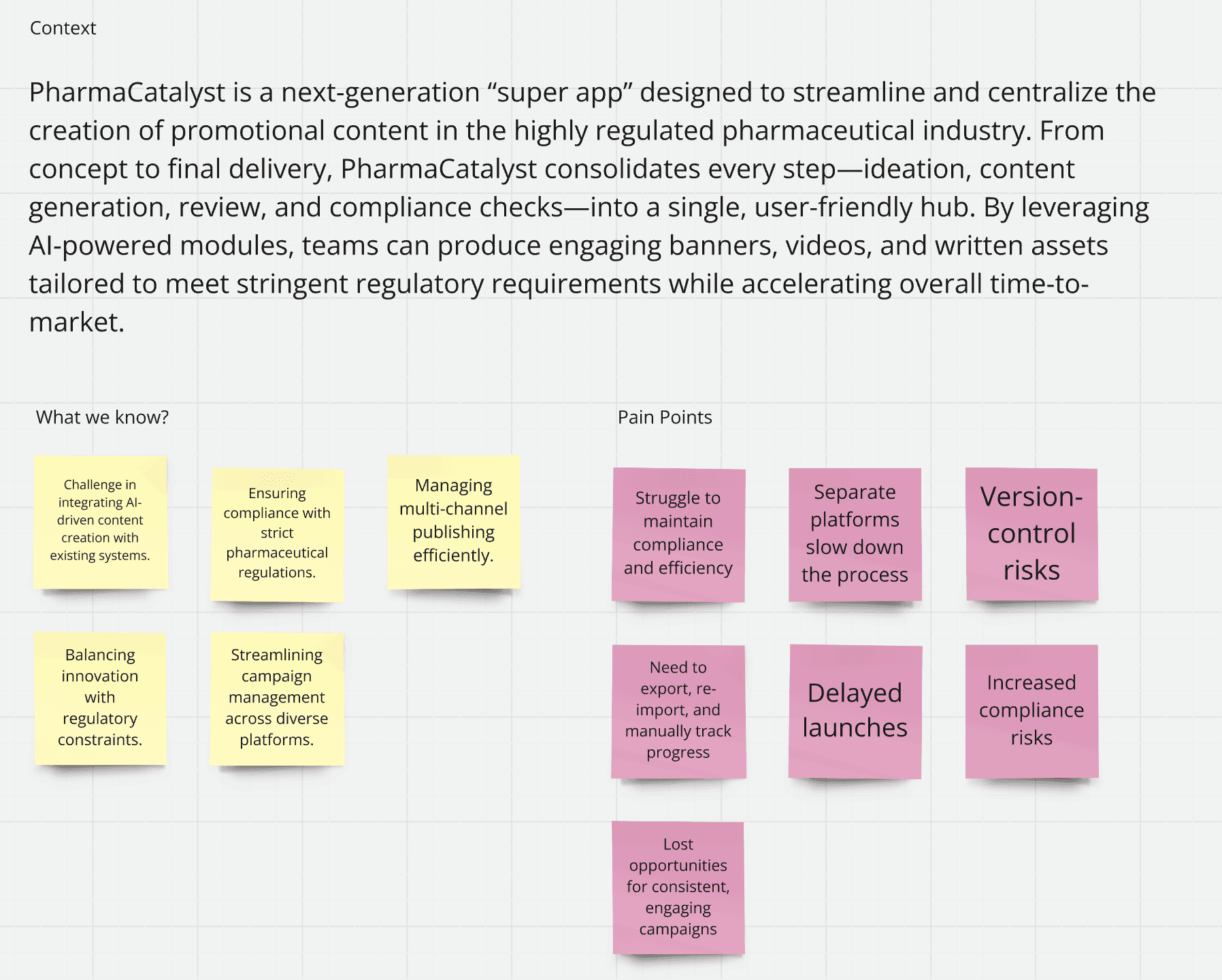


Design
Wireframe
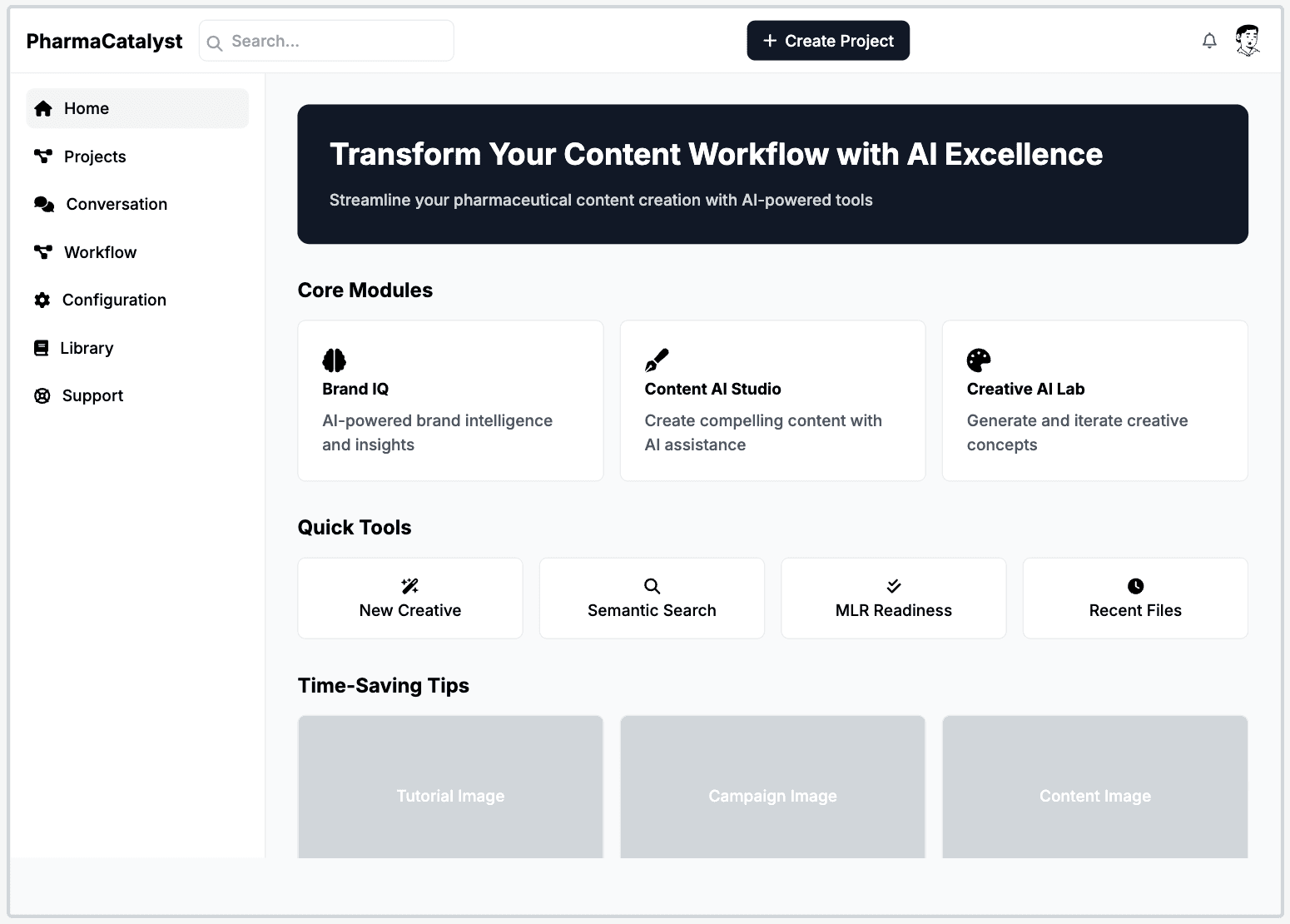
We identifieUnified Campaign & Project Creation
Users can establish a campaign or project as a central hub for all related assets, tasks, and outputs.
AI-Driven Content Generation (from brief + metadata)
Users provide a summary and metadata (such as drug, audience, channel, objective, claims constraints). The system then produces:
Drafts of promotional copy
Image concepts and creative variants
Reusable content blocks
Creative Generation Designed for Promotion
AI-generated visuals are created to be directly integrated into campaign materials like social media, emails, web banners, and more.MLR Readiness Support
Rather than addressing compliance at the end, the system structures content early on, enabling teams to:
Minimize back-and-forth revisions
Expedite review-ready package preparation
Maintain consistency of artifacts across iterations
Asset & Knowledge Reuse
A library combined with a replicator/transcreation tool helps reduce repetitive work and supports scaling across campaigns.
Final Version
Outcome
With PharmaCatalyst, pharmaceutical marketing teams can confidently ideate, create, review, and distribute promotional assets in a fraction of the time once required. By merging AI-powered innovation, regulatory intelligence, and collaborative workflows, this super app redefines how drug promotions are developed, enabling faster launches, improved compliance, and a strategically consistent brand experience worldwide.